A care worker weighing up two employers doesn’t open your careers site any more. She opens ChatGPT, and asks it whether you’re worth applying to.
“Is [Employer] a good place to work? Are there enough available shifts? What’s the night-shift pay actually like? Better than [Competitor]?” Whatever comes back (confident, cited, sometimes wrong) decides whether she ever clicks through to you at all.
That conversation is part of your candidate experience now. Most employers have no idea what it says about them.
So when Google published its official guide to showing up in AI search on 5 June, it was answering a question I’ve watched get more urgent every month. The guide is worth reading in full, and most of it is refreshingly free of hype.
What Google actually says
The headline message is that there’s no new discipline to learn. Google’s AI features run on the same ranking and quality systems as ordinary Search, so the SEO you already know is the preparation that counts.
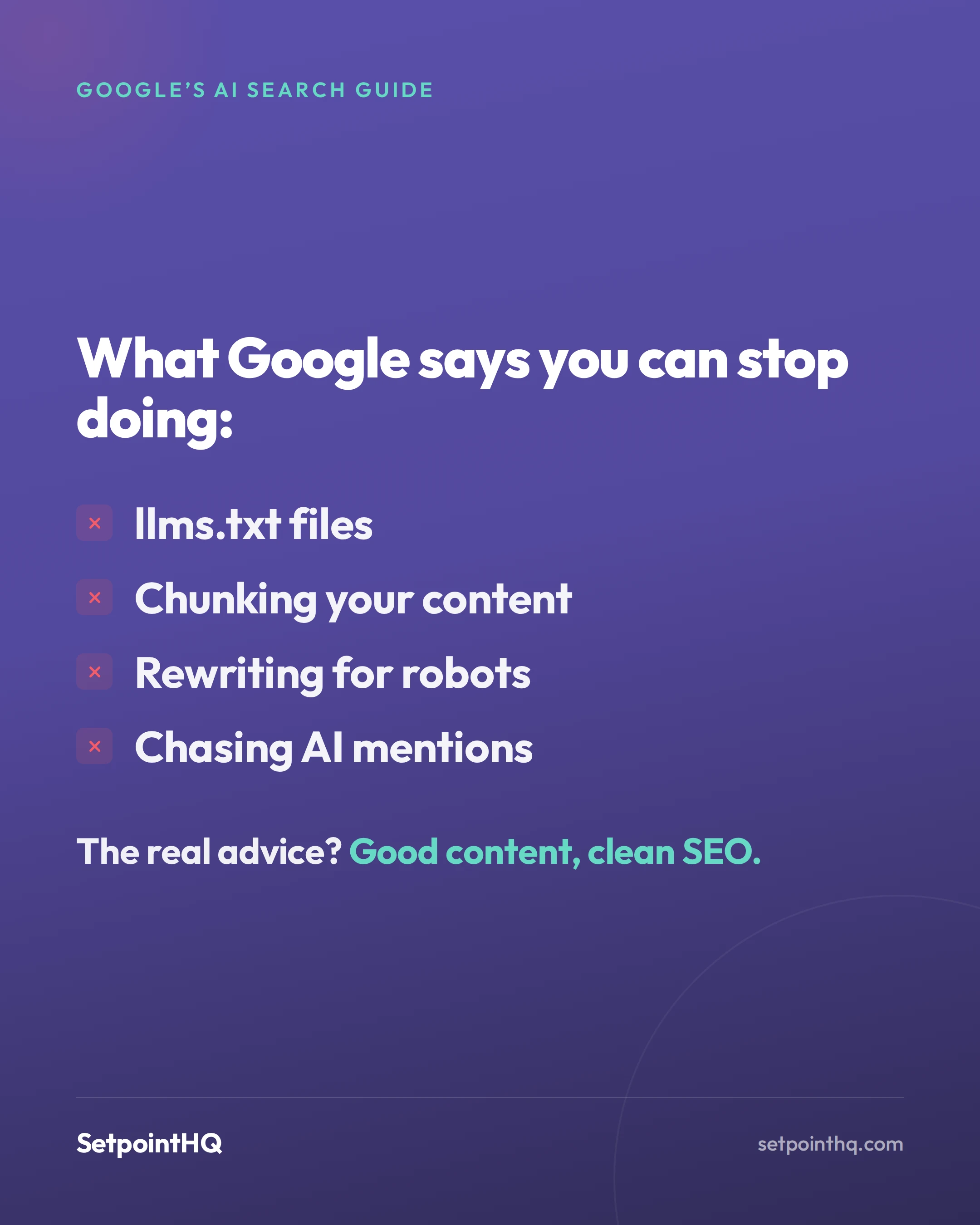
It spends a good part of the guide talking people out of the cottage industry that’s grown up around “AEO” and “GEO”. You don’t need an llms.txt file. You don’t need to chop your content into bite-sized chunks for the machines. You don’t need to rewrite everything in robot-friendly prose. And chasing inauthentic mentions won’t move you an inch.
For most website owners, that’s good, money-saving advice. Write genuinely useful content from real experience, keep the technical side clean, make your pages easy to crawl. Nothing exotic.
The part that matters for employer brands
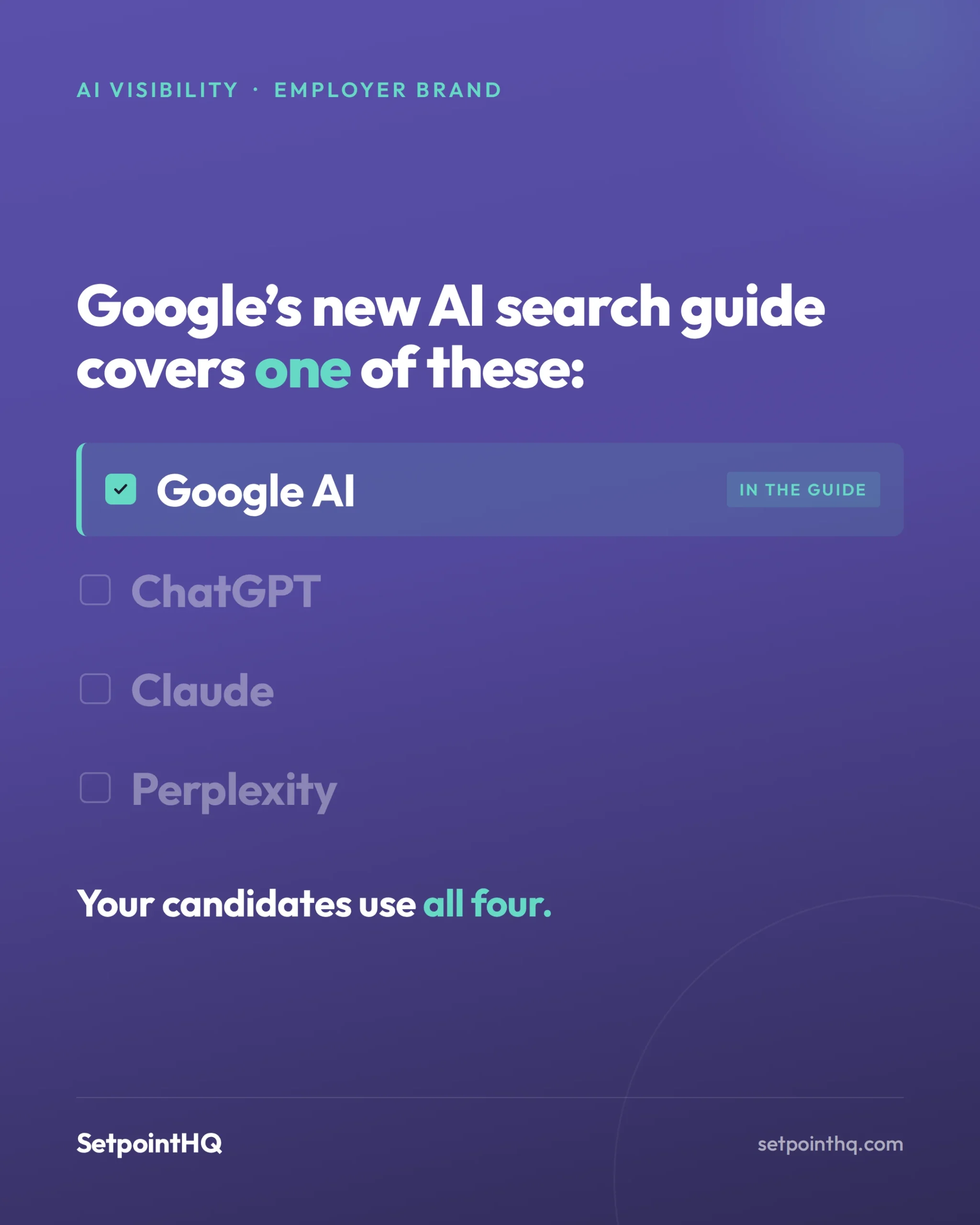
Here’s where I’d stop nodding along and read more carefully. Look at what the guide is actually about: Google’s own AI features. AI Overviews and AI Mode, inside Google Search. That’s the whole remit. It says nothing about any AI surface that isn’t Google’s, because it can’t.
And for hiring, those other surfaces are where the conversation is happening. When a candidate opens ChatGPT, Claude or Perplexity to size you up as an employer, none of those tools follow Google’s guidance, and none of them publish a guide of their own. They each crawl, retrieve and cite differently.
So you can read beautifully in Google’s AI Overviews and be invisible, or quietly misrepresented, in the assistant a candidate actually used to build their shortlist. Google has drawn a tidy line around its own patch and left everything outside it unmapped.
And here’s the update that makes the point sharper. On 3 June, two days before that guide, Google quietly shipped a Search Console report that measures how often you surface inside its own AI answers: AI Overviews and AI Mode. So the scoreboard isn’t hypothetical any more. Google just built one. It covers exactly one of the four assistants your candidates use, it counts impressions rather than whether you’re cited or what’s actually said about you, and it’s rolling out to a subset of sites first. Free, useful, and a quarter of the picture.
A word on schema, since Google brought it up
The guide makes a point of playing down structured data, so it’s worth being precise. Google saying schema isn’t required for its AI features is not the same as schema being pointless. It still earns rich results, and it still helps a machine work out who you are and tell you apart from the dozen other organisations with a near-identical name.
What it isn’t is a single lever you pull to become visible to AI. The employers getting this wrong tend to sit at one of two extremes: obsessing over markup as if it’s magic, or ripping it out the moment Google waves it off. Both are guessing. Treat schema as one signal worth measuring, not a silver bullet.
What I’d actually do about it
Do everything the guide says. Genuinely useful content about working for you, clean technical foundations, crawlable pages. Switch on Google’s new AI report while you’re at it. It’s free, and it shows you its own surface. Then, and this is the bit nobody hands you for free, find out whether any of it is landing across the assistants your candidates actually use.
That’s why we built The SetpointHQ Index: to track how visible UK employer brands are to AI assistants and search over time, scored on the things that genuinely shift the outcome rather than the ones that are easy to count. The same thinking sits behind SetpointHQ Pro, our longitudinal AI-visibility tracking for talent and employer-brand teams.
If you want a clear read on where you stand before your next hiring campaign, that’s exactly what the £999 Recruitment Marketing Audit is for. It scores your whole hiring system, including how you show up to AI, and hands you a prioritised plan for the things quietly costing you applications. If AI visibility specifically is the worry keeping you up, talk to us about Pro.
The scoreboard you still can’t see
Google is right that there are no magic words for the machines, and it’s just handed you a scoreboard for its own AI answers, which is worth switching on. But it covers one assistant of four, in impressions only. “Do good SEO and hope” stops being a strategy the moment you realise three-quarters of the scoreboard is still dark.