A software engineer weighing up her next move doesn’t type “software engineer jobs near me” into Google any more. She opens ChatGPT on a Sunday evening and asks which companies near her actually treat their engineers well.
The AI answers in four sentences. It names three employers. Yours is not one of them.
No job board fee was undercut. No advert was outbid. You simply weren’t credible enough, in the eyes of a machine, to be recommended. That’s the shift every recruiter, talent acquisition team and staffing agency now has to take seriously. Search engine optimisation built the last twenty years of candidate attraction. Generative engine optimisation will decide the next twenty, and the two games have different rules.
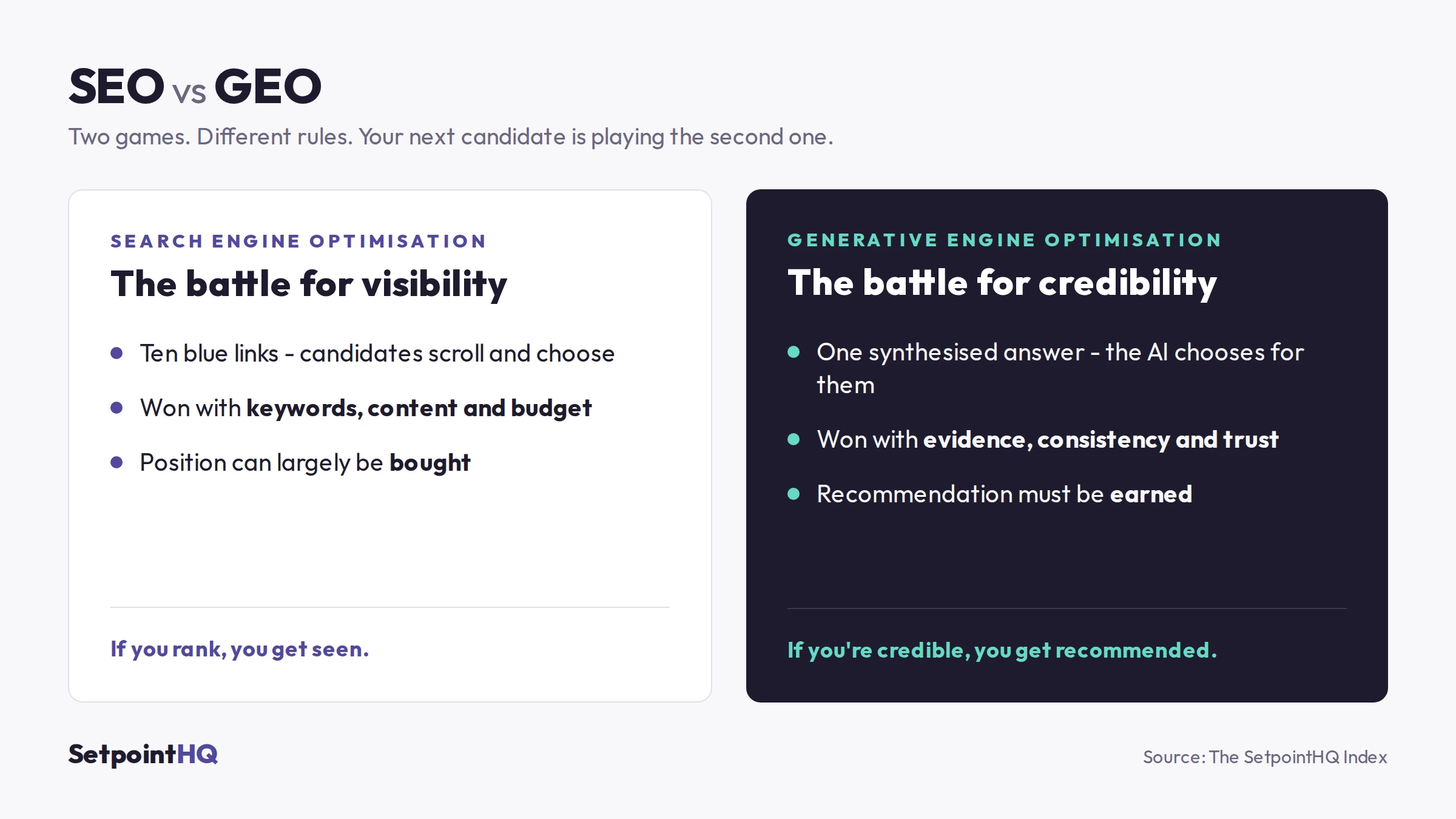
What is SEO? The battle for visibility
Search engine optimisation (SEO) is the discipline of making your careers site, job adverts and employer content rank in traditional search engines like Google and Bing. For recruitment teams it’s a familiar checklist: keyword-optimised job titles, fast careers pages, location landing pages, backlinks from job boards and industry press, and technical hygiene like sitemaps and canonical tags.
SEO is fundamentally a battle for visibility. Ten organic positions, paid listings above them, and a click-through curve that collapses after position three. If you ranked, candidates saw you. If you didn’t, they didn’t. And because the contest was about presence, it became something you could largely buy: job aggregators, programmatic advertising and agencies industrialised it years ago.
What is GEO? The battle for credibility
Generative engine optimisation (GEO) is the discipline of making your employer brand visible, accurate and recommendable inside AI assistants and AI-powered search: ChatGPT, Claude, Perplexity, Google Gemini and the AI Overviews now sitting on top of Google itself.
These systems don’t return ten links. They return an answer. One synthesised recommendation, drawn from what the model can find, verify and trust about you: your careers site content, your structured data, your presence in knowledge graphs, how often credible sources cite you, what reviews and press say about how you treat people.
That makes GEO a battle for credibility. An AI assistant isn’t asking “who paid to be here?” It’s asking “who can I confidently recommend?” It cross-references. It weighs evidence. And it punishes thin, inconsistent or invisible employer information by simply leaving you out of the answer.
You can’t buy your way into that answer the way you bought a sponsored job slot. You have to deserve your way in. Generative engine optimisation for recruitment goes deeper on the mechanics. Its sibling discipline, answer engine optimisation, is about winning the final answer itself rather than getting into the working material behind it.
Why this matters more in hiring than almost anywhere else
Hiring is a trust decision on both sides. Candidates have always researched employers before applying. What’s changed is the research tool. They increasingly ask AI assistants the questions they used to ask friends. What’s it really like to work there? Is the pay competitive? Is on-call brutal? Which teams actually respect your time outside work?
In competitive, candidate-short fields like software engineering, data and cybersecurity, where the strongest people field several offers at once and every team chases the same shrinking pool of senior talent, the cost of being absent from those answers compounds weekly.
And here’s the part that should change behaviour in every boardroom: being a good employer has never been more commercially important. Generative engines synthesise the totality of your reputation: review patterns, Glassdoor signals, news coverage, how your job adverts read, whether your careers site answers candidates’ real questions. SEO let a mediocre employer with a big media budget out-shout a good one. GEO does the opposite. It rewards employers whose evidence genuinely supports “this is a good place to work” and quietly filters out those whose evidence doesn’t.
Marketing spin used to paper over operational cracks. AI assistants read through the paper.
SEO isn’t dead. GEO sits on top of it
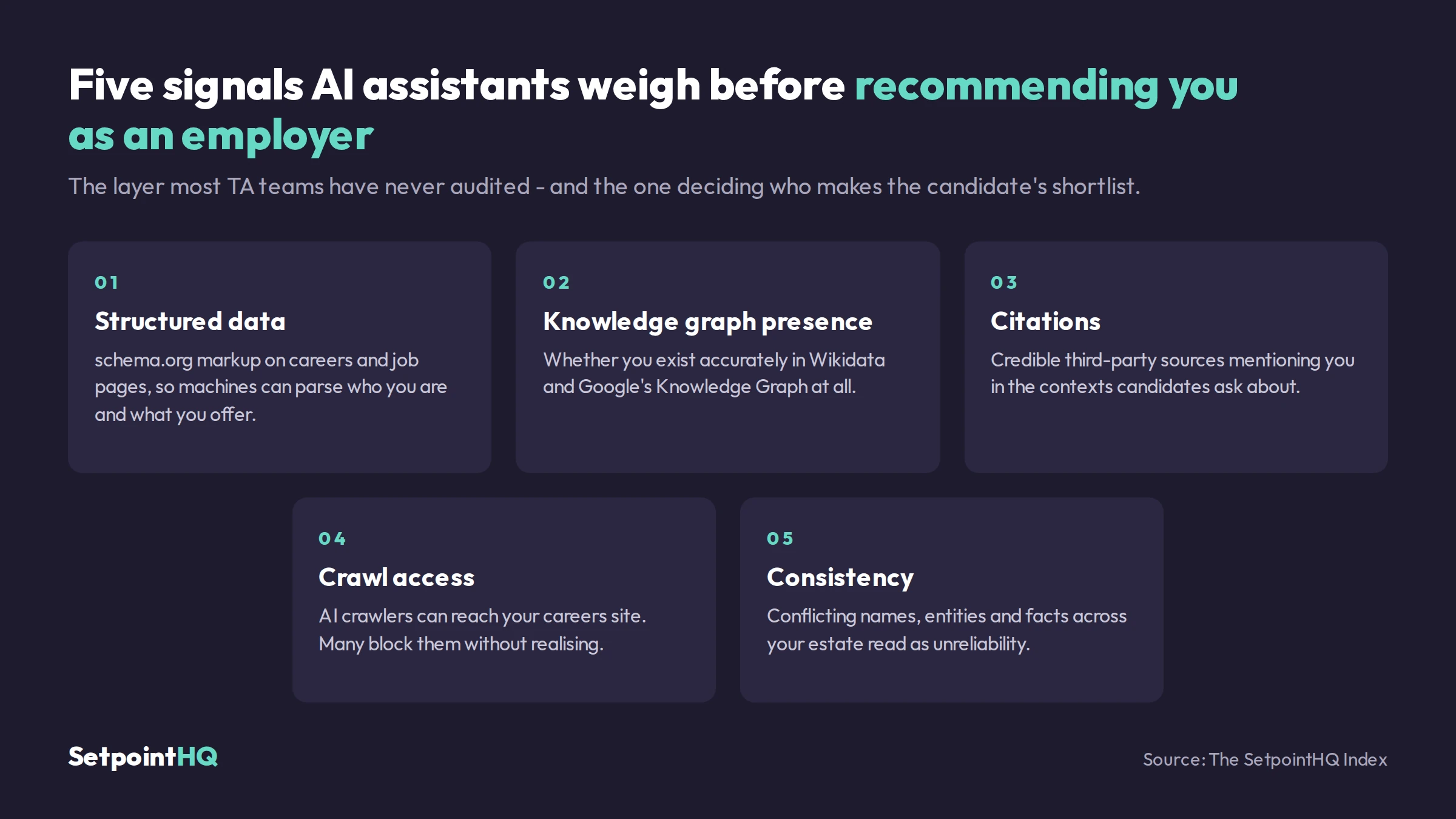
This isn’t a replacement story; it’s a stacking story. The fundamentals of recruitment SEO still matter (crawlable careers sites, clean technical infrastructure, quality content) because they’re part of what generative engines ingest. But GEO adds a layer most TA teams have never audited, and it overlaps heavily with the signals that decide whether an assistant can see your employer brand at all:
- Structured data: schema.org markup on every careers and job page, so machines can parse who you are, what you offer and where
- Knowledge graph presence: whether your organisation exists accurately in Wikidata and Google’s Knowledge Graph at all
- Citations: whether credible third-party sources mention you in the contexts candidates ask about
- Crawl access: many careers sites block AI crawlers without realising
- Consistency: conflicting names, entities and facts across your digital estate read as unreliability to a model
That chain, from crawled to read to cited, breaks at the first link more often than anywhere else.
When we score UK employer brands for The SetpointHQ Index (our longitudinal study of AI visibility across ChatGPT, Claude, Perplexity and Gemini, covering 100 UK employer brands), the recurring finding isn’t a poor score. It’s a zero. Household-name employers with eight-figure recruitment budgets returning no structured data on their careers pages, or entirely absent from the knowledge graphs AI assistants lean on. Invisible in the exact channel their next decade of candidates is moving to, and most don’t know it.
The arms race has already started
The uncomfortable part of GEO is the timing. AI assistants build their picture of your employer brand from accumulated evidence, and the employers fixing their structured data, knowledge graph presence and citation footprint now are compounding an advantage that gets harder to claw back every month. When three competitors are consistently the recommended answer for “best companies for engineers to work for”, they absorb the candidate flow, the reviews, the coverage and the citations that make them even more recommendable next quarter.
That’s an arms race in the strict sense: the cost of catching up rises the longer you wait. In SEO, a late entrant could buy position. In GEO, a late entrant has to out-earn an incumbent’s accumulated credibility. Recruitment leaders who treat this as a 2027 problem will spend 2027 explaining why application volumes fell while the media budget didn’t.
What we’d actually do about it
Three moves, in order.
Measure where you stand. You can’t manage AI visibility you’ve never seen. Ask the four major assistants the questions your candidates ask and see whether you appear, then go deeper into your structured data, crawl access and knowledge graph presence. If you are weighing up providers rather than doing it yourself, how to choose an AI visibility audit sets out five criteria and four red flags.
Fix the machine-readable layer. Schema on every careers and job page, an accurate organisational entity, AI crawlers unblocked, consistent facts everywhere your brand appears.
Earn the credibility layer. Content that answers real candidate questions, third-party citations, and an employee experience whose evidence trail supports the story. GEO ultimately makes recruitment marketing and operational reality converge, which is exactly why being good matters more than it ever has.
If you want a clear read before your next hiring campaign, that’s what the £999 Recruitment Marketing Audit is for. It scores your whole hiring system, including how visible and credible you are to AI, and hands you a prioritised 90-day plan within 7 working days. The full seven-area version of that framework is written up in our recruitment website audit guide. And if you need the scoreboard running continuously, talk to us about Pro, our longitudinal AI-visibility tracking for talent and employer-brand teams.
Find out where you stand before your next campaign.
The Recruitment Marketing Audit scores your whole hiring system, AI visibility and credibility included, and returns a prioritised 90-day plan within 7 working days. £999.
Want our help? Get in touch →
Start with a free careers site audit →
Frequently asked questions
What is the difference between SEO and GEO in recruitment?
SEO makes your careers site and job adverts rank in traditional search engines like Google and Bing. It is a battle for visibility, and budget can buy position. GEO makes your employer brand accurate and recommendable inside AI assistants like ChatGPT, Claude, Perplexity and Gemini. It is a battle for credibility, and you have to earn your way into the answer.
Can you pay to appear in AI assistant recommendations?
No. Unlike a sponsored job slot, there is no paid placement inside a synthesised AI answer. The assistant weighs evidence about how recommendable you are: structured data, knowledge graph presence, citations, reviews and the content on your careers site. You deserve your way in rather than buy it.
Which AI assistants matter for employer brand visibility?
The four that candidates use most are ChatGPT, Claude, Perplexity and Google Gemini, plus the AI Overviews now sitting on top of Google search itself. The SetpointHQ Index tracks employer brand visibility across all four.
Does SEO still matter if GEO is the future?
Yes. GEO does not replace SEO, it stacks on top of it. Crawlable careers sites, clean technical infrastructure and quality content are part of what generative engines ingest, so the SEO fundamentals still count. GEO adds a credibility layer most TA teams have never audited.
How do I find out if my employer brand is visible to AI?
Start by asking the four major assistants the questions your candidates ask and noting whether you appear. For a readiness check on your careers site, the free careers site audit covers crawler access and structured data and comes back inside three working days. For a full read, the £999 Recruitment Marketing Audit scores your whole hiring system, including AI visibility and credibility, and returns a prioritised 90-day plan within 7 working days.
The answer is being written without you
The candidates have already moved. The engines are already answering. Every week you wait, the answer about your sector gets a little more settled, and a little harder to rewrite. The only question is whether it includes you.